
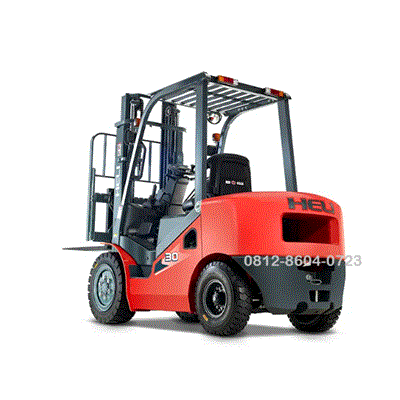
Heli Forklift CPCD30 | 3 ton
Heli Forklift CPCD30 | 3 ton
Performance & Capacity
Rated Capacity 3,000 kg (3 Ton).
Load Center 500 mm.
Lift Height (Standard) 3,000 mm (3 meters).
Lift Height (Options) Duplex/Triplex masts available up to 6,000 mm.
Max Travel Speed 18 – 20 km/h (Laden/Unladen).
Lift Speed 470 – 520 mm/s.
Description
Heli Forklift CPCD30 | 3 ton
The Heli CPCD30 is a 3-ton diesel forklift, a staple in the Heli “H Series” and “H3 Series” lineup.
It is widely recognized for its balance of performance and cost-effectiveness, commonly used in warehouse and manufacturing environments.
Below are the primary technical specifications for the standard model:
Performance & Capacity
Rated Capacity 3,000 kg (3 Ton).
Load Center 500 mm.
Lift Height (Standard) 3,000 mm (3 meters).
Lift Height (Options) Duplex/Triplex masts available up to 6,000 mm.
Max Travel Speed 18 – 20 km/h (Laden/Unladen).
Lift Speed 470 – 520 mm/s.
Engine Options
The CPCD30 is often configured with different engines depending on the region and specific series (H2000, G, or H3):
Xinchai 490/498 (China): Common, robust, and easy to maintain. Output approx. 37 kW @ 2650 rpm.
Isuzu C240 (Japan): High reliability and smoother operation. Output approx. 35.4 kW.
Mitsubishi S4S (Japan): Often found in the H3 Series for better fuel efficiency and lower emissions.
Kubota V2403: Found in newer Euro V compliant models.
Dimensions & Weight
Operating Weight: Approx. 4,280 – 4,400 kg.
Overall Length (without forks): ~2,700 mm.
Overall Width: 1,225 mm.
Overhead Guard Height: ~2,090 mm.
Turning Radius: 2,420 mm.
Fork Dimensions: 1,070 mm x 125 mm x 45 mm (Standard).
Key Features
Transmission: Hydraulic / Powershift (Automatic) is standard for the “CPCD” designation (“CPC” typically denotes manual).
Mast: Wide-view mast design to improve operator visibility.
Tires: Pneumatic tires are standard (Front: 28×9-15; Rear: 6.50-10). Solid tires are optional for puncture-prone environments.
Ergonomics: Adjustable seat, smaller steering wheel, and improved foot space compared to older generations.
Note: Specifications can vary slightly based on the specific “Series” (e.g., K-Series vs. H3-Series). If you are looking at a specific unit, I recommend checking the nameplate on the side of the chassis for the exact engine and mast configuration.
Would you like me to help you compare this model against another brand like Toyota or Komatsu?


Reviews
There are no reviews yet.