
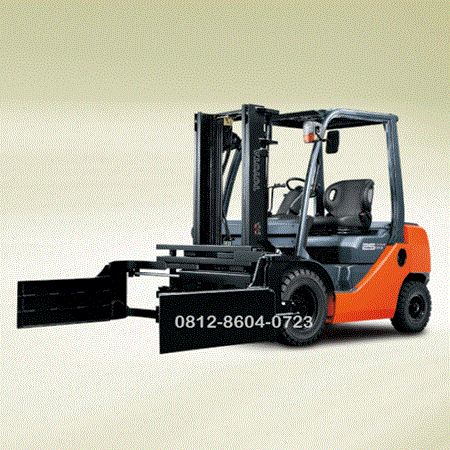
Bale Clamp Attachment
Bale Clamp Attachment
Primary Load Specifications
These determine if the clamp can physically lift and hold your specific bales.
Capacity @ Load Center: The maximum weight the clamp can handle at a specific distance from the carriage (typically 500 mm or 600 mm). Common capacities range from 1,900 kg to 4,500 kg.
Opening Range: The minimum and maximum distance between the arms.
Standard Range: Usually between 450 mm (closed) and 1,700+ mm (fully open).
Clamping Force: The pressure exerted by the arms. This is often adjustable via a hydraulic pressure relief valve to prevent crushing sensitive materials like wool or foam.
Description
Bale Clamp Attachment
BELIALAT.COM support penjualan unit, parts, service, rental, maintenance contract, overhaul, reconditioned Bale Clamp Attachment
A Bale Clamp is a hydraulic forklift attachment designed to handle non-palletized, baled materials such as cotton, wool, scrap metal, recycled paper, and hay.
When reviewing a specification sheet for a bale clamp, there are several technical metrics you need to align with your forklift’s capabilities and the nature of your cargo.
Primary Load Specifications
These determine if the clamp can physically lift and hold your specific bales.
Capacity @ Load Center: The maximum weight the clamp can handle at a specific distance from the carriage (typically 500 mm or 600 mm). Common capacities range from 1,900 kg to 4,500 kg.
Opening Range: The minimum and maximum distance between the arms.
Standard Range: Usually between 450 mm (closed) and 1,700+ mm (fully open).
Clamping Force: The pressure exerted by the arms. This is often adjustable via a hydraulic pressure relief valve to prevent crushing sensitive materials like wool or foam.
Physical & Technical Dimensions
These specs affect the forklift’s stability and maneuverability.
Specification | Description
Mounting Class
Usually Class II, III, or IV to match the forklift’s carriage size.
Arm Size (H x L)
The height and length of the clamping blades. Longer arms are needed for deep loads, while thin profiles help “knife” between tight stacks.
Effective Thickness (ET)
Also called “Lost Load.” This is the thickness the attachment adds to the front of the forklift, which reduces the truck’s overall lifting capacity.
Center of Gravity (VCG/HCG).
The Vertical and Horizontal centers of gravity. These are critical for calculating the residual capacity of your forklift.
Frame Width
The total width of the attachment’s backplate; must be compatible with your narrowest operating aisle.
Operational Features
Sideshifting: Allows the operator to move the entire load left or right without moving the truck. This is standard on most modern bale clamps.
Rotation (Optional): Some clamps offer 360° rotation for inverting loads or emptying contents.
Arm Facing: * Ribbed/Serrated: For high-friction grip on textiles or scrap.
Smooth/Round Bar: For delicate pulp or finished paper products to prevent tearing.
Hydraulic Requirements: Most bale clamps require two auxiliary hydraulic functions (one for clamping/opening and one for sideshifting).
Key Consideration: Residual Capacity
Installing a bale clamp significantly reduces your forklift’s original rated capacity. Because the attachment is heavy and pushes the load further forward, you must use the manufacturer’s formula (or a new data plate) to determine the “Net” or “Residual” capacity.
Formula Note: A x (B+C) – D x (E+F)/(B+G+H)
(Where variables represent truck capacity, load centers, and attachment weights/offsets).
Would you like me to help you calculate the residual capacity for a specific forklift model and clamp weight?


Reviews
There are no reviews yet.