
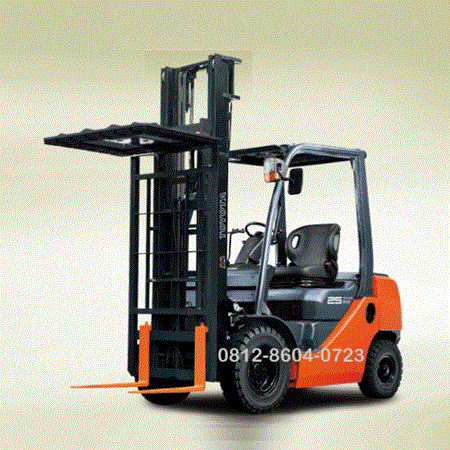
Load Stabilizer Attachment
Load Stabilizer Attachment
Key Performance Specifications
When reviewing a specification sheet, these are the primary metrics that determine if the attachment fits your application:
Parameter Description Typical Range.
Rated Capacity The maximum weight the clamp can safely handle at a specific load center. 1,500 kg – 8,000 kg.
Opening Range The distance between the arms (minimum to maximum). 300 mm – 2,000 mm.
Arm Length The depth of the clamping surface (must match your stack depth). 1,000 mm – 1,400 mm.<br />Arm Height The vertical surface area of the clamp pad. 200 mm – 600 mm.
Mounting Class The ISO/ITA carriage class of the forklift (must match). Class II, III, or IV.
Lost Load Center The thickness of the attachment that pushes the load forward. 150 mm – 250 mm.
Description
Load Stabilizer Attachment
BELIALAT.COM support penjualan unit, parts, service, rental, maintenance contract, overhaul, reconditioned Load Stabilizer Attachment
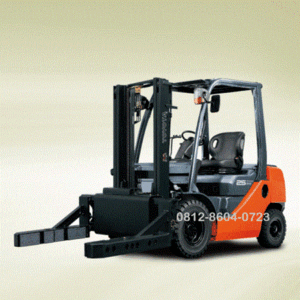
A Forklift Load Stabilizer is a hydraulic attachment used to secure unstable, tall, or fragile loads from the top, allowing for faster and safer transport—especially over uneven terrain.
lass=”yoast-text-mark” />>Below are the typical specifications and technical data for standard units (based on industry standards from manufacturers like Cascade and KAUP).
Typical Performance Specifications
These units generally fall into the 1,500 kg to 3,500 kg capacity range. Note that the “Net Capacity” is usually lower than the forklift’s rated capacity because the attachment adds weight and shifts the load center forward.
Feature Standard Specification Range
Load Capacity 1,500 kg – 3,500 kg (3,300 lbs – 7,700 lbs)
Opening Range (Vertical) 900 mm – 2,200 mm (varies by model)
Contact Pad Size 1,000 x 1,000 mm up to 1,200 x 1,400 mm
Hydraulic Pressure 120 bar – 160 bar (1,700 – 2,300 PSI)
Required Hydraulic Functions 1 function (Clamp only) or 2 (Clamp + Sideshift)
Mounting Class ISO Class II or III (FEM 2 or FEM 3)
Physical & Operational Dimensions
Effective Thickness (Lost Load Center): Typically between 250 mm and 350 mm. This is the distance the attachment adds to the front of the carriage.
lass=”yoast-text-mark” />>Horizontal Center of Gravity (CGH): Usually ranges from 100 mm to 250 mm from the fork face.
lass=”yoast-text-mark” />>Attachment Weight: A standard unit weighs between 180 kg and 350 kg, depending on whether it includes an integrated side-shifter.
>Clamping Force: Often adjustable via an internal relief valve, typically peaking around 3,500 N to 5,000 N (to prevent crushing fragile goods like bottled water).
Key Components & Variants
When selecting a unit, specifications vary based on these three design types:
Non-Sideshifting: Fixed frame; lighter weight; requires 1 hydraulic auxiliary valve.
Sideshifting: Allows the entire stabilizer and forks to move left/right; improves productivity; requires 2 hydraulic auxiliary valves.
Application-Specific Specs
Beverage Industry: Large pads (1,100mm+) with high-friction rubber to grip plastic-wrapped pallets.
Empty Containers: Lightweight frames with high opening ranges (up to 2,400mm) for stacking tall, light loads.
Rough Terrain: Heavy-duty cylinders with “accumulators” to act as shock absorbers for the clamp.
Important Safety Note: Adding a load stabilizer requires a New Capacity Plate for your forklift. OSHA and international standards require the combined “derated” capacity to be calculated and displayed on the truck.


Reviews
There are no reviews yet.