
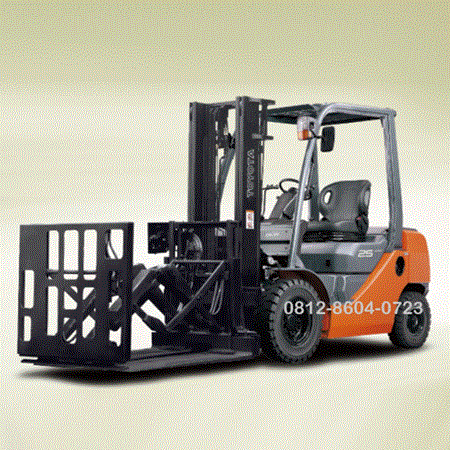
Push Pull Attachment
Push Pull Attachment
Key Performance Specifications
Most standard units fall into these ranges:
Feature Standard Range Heavy Duty Range.
Capacity 1,500 kg – 2,000 kg 2,500 kg – 4,500 kg.
Load Center 600 mm (24″) 600 mm (24″).
Stroke (Reach) 1,200 mm – 1,400 mm Up to 1,600 mm.
Mounting Class ITA Class II or III ITA Class III or IV.
Unit Weight 350 kg – 550 kg 600 kg – 900 kg.
Sideshift ± 100 mm (Optional) ± 100 mm (Optional).
Description
Push Pull Attachment
BELIALAT.COM support penjualan unit, parts, service, rental, maintenance contract, overhaul, reconditioned Push Pull Attachment
Forklift Push-Pull attachments are hydraulic units designed to handle loads on thin slip sheets (plastic or fiberboard) instead of traditional wooden pallets.
This significantly increases cargo space in shipping containers and reduces pallet costs.
Below are the typical technical specifications and categories you will find for these units.
Key Performance Specifications
Most standard units fall into these ranges:
Feature Standard Range Heavy Duty Range.
Capacity 1,500 kg – 2,000 kg 2,500 kg – 4,500 kg.
Load Center 600 mm (24″) 600 mm (24″).
Stroke (Reach) 1,200 mm – 1,400 mm Up to 1,600 mm.
Mounting Class ITA Class II or III ITA Class III or IV.
Unit Weight 350 kg – 550 kg 600 kg – 900 kg.
Sideshift ± 100 mm (Optional) ± 100 mm (Optional).
Hydraulic Requirements
A push-pull attachment requires hydraulic power from the forklift to operate the “gripper” and the “push plate.”
Auxiliary Functions: Requires 1 or 2 auxiliary hydraulic circuits (depending on whether you have a sideshift or “sheet saver” function).
Operating Pressure: Typically 140 – 160 bar (approx. 2,000–2,300 PSI).
Flow Rate: Recommended 20 – 30 Liters/min (approx. 5–8 GPM).
Core Components & Features
Platen (Faceplate): The flat “forks” that slide under the load. They are wider and thinner than standard forks to prevent damaging the slip sheets.
Gripper Bar: A hydraulic clamp at the bottom of the push plate that grabs the “tab” of the slip sheet to pull the load onto the platens.
Push Plate: The vertical grate that pushes the load off the platens when unloading.
Sheet Saver (Optional): A specialized mechanism that holds the slip sheet in place while pushing the load off, allowing you to reuse the slip sheet.
Mounting Types
Carriage Mount (Dedicated): The attachment is permanently (or semi-permanently) bolted to the forklift carriage. This offers the best “lost load” center and higher residual capacity.
Quick Fork Mount (Slip-on): The attachment has pockets that slide over your existing forklift forks. It is ideal for facilities that only use slip sheets occasionally, as it can be installed or removed in minutes.
Essential Selection Factors
When choosing a unit, you must verify:
Residual Capacity: Because the attachment is heavy and extends the load forward, it “de-rates” your forklift. A 2.5-ton forklift might only be able to lift 1.8 tons with a push-pull attached.
Faceplate Width: Ensure the platens are wide enough to support the specific dimensions of your bags, boxes, or sacks.
Voltage: If using an electric solenoid valve to switch between functions, ensure it matches your forklift’s battery voltage (e.g., 12V, 36V, or 48V).
Would you like me to find a specific brand’s spec sheet (like Cascade, Bolzoni, or KAUP) for a particular forklift model?


Reviews
There are no reviews yet.