
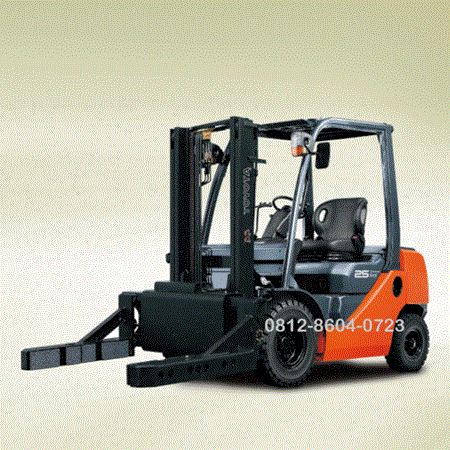
Block Clamp Attachment
Block Clamp Attachment
Key Performance Specifications
When reviewing a specification sheet, these are the primary metrics that determine if the attachment fits your application:
Parameter Description Typical Range.
Rated Capacity The maximum weight the clamp can safely handle at a specific load center. 1,500 kg – 8,000 kg.
Opening Range The distance between the arms (minimum to maximum). 300 mm – 2,000 mm.
Arm Length The depth of the clamping surface (must match your stack depth). 1,000 mm – 1,400 mm.
Arm Height The vertical surface area of the clamp pad. 200 mm – 600 mm.
Mounting Class The ISO/ITA carriage class of the forklift (must match). Class II, III, or IV.
Lost Load Center The thickness of the attachment that pushes the load forward. 150 mm – 250 mm.
Description
Block Clamp Attachment
BELIALAT.COM support penjualan unit, parts, service, rental, maintenance contract, overhaul, reconditioned Block Clamp Attachment
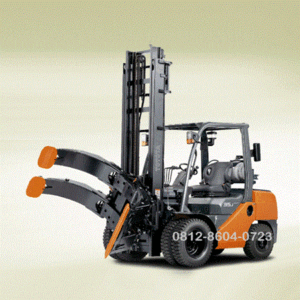
>Unlike standard forks, block clamps use lateral pressure to grip the load securely.
The specifications below represent industry standards for attachments compatible with 1.5-tonne to 10-tonne forklifts.
Key Performance Specifications
When reviewing a specification sheet, these are the primary metrics that determine if the attachment fits your application:
Parameter Description Typical Range.
Rated Capacity The maximum weight the clamp can safely handle at a specific load center. 1,500 kg – 8,000 kg.
Opening Range The distance between the arms (minimum to maximum). 300 mm – 2,000 mm.
Arm Length The depth of the clamping surface (must match your stack depth). 1,000 mm – 1,400 mm.
Arm Height The vertical surface area of the clamp pad. 200 mm – 600 mm.
Mounting Class The ISO/ITA carriage class of the forklift (must match). Class II, III, or IV.
Lost Load Center The thickness of the attachment that pushes the load forward. 150 mm – 250 mm.
Physical & Technical Attributes
Beyond the basic dimensions, the construction of the clamp affects its longevity and safety.
Frame Construction: High-strength steel profiles (often T-beam or sliding arm designs) to ensure stability under high clamping pressure.
Sideshift Function: Most modern block clamps include an independent sideshift (typically $\pm100$ mm) to allow precise placement without moving the forklift.
Clamping Pads: Often equipped with vulcanized rubber or polyurethane surfaces to prevent chipping or breaking the blocks.
Bearings: High-performance units use UHMW (Ultra-High Molecular Weight) polyethylene bearings which are self-lubricating and reduce maintenance.
Hydraulic Requirements
To operate a block clamp, your forklift must be equipped with specific hydraulic capabilities:
Hydraulic Functions: Usually requires two auxiliary functions (one for clamping/opening and one for sideshifting).
Pressure Relief Valve: Essential for protecting the load; it allows the operator to adjust the clamping force so the blocks are held securely but not crushed.
Operating Pressure: Typically ranges from 120 to 160 bar, depending on the manufacturer.
Critical Safety: Residual Capacity
You must calculate the Residual Capacity because:
The attachment itself is heavy (often 400 kg – 1,000 kg).
>The attachment moves the center of gravity of the load further forward (Effective Thickness).
Note: Always check the Load Capacity Plate on your forklift.
OSHA and international standards require a new data plate to be issued whenever an attachment like a block clamp is installed.
Would you like me to help you calculate the estimated residual capacity for a specific forklift model and block weight?


Reviews
There are no reviews yet.