
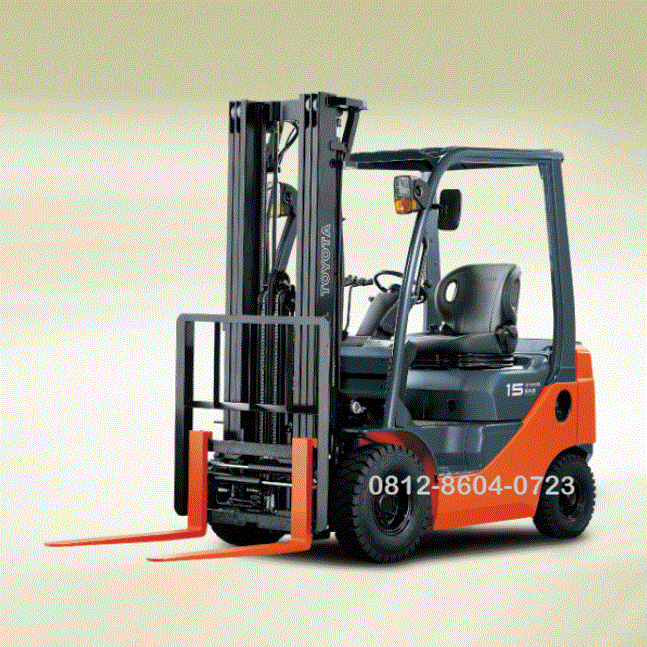
Fork Positioner Attchment
Fork Positioner Attchment
Core Technical Specifications
When selecting a fork positioner, manufacturers typically provide the following data points:
Specification Typical Range / Description.
Capacity 1,000 kg (2,200 lbs) up to 12,000 kg (26,000+ lbs).
ISO / FEM Class Class II, III, IV, or V (Matches forklift carriage).
Opening Range From “0” (forks touching) to wider than the truck frame.
Lost Load (Effective Thickness) 30 mm – 150 mm (Impacts residual capacity).
Center of Gravity (HCG) Horizontal distance from the carriage to the attachment’s CoG.
Weight 150 kg – 900+ kg (Depending on size/class).
Description
Fork Positioner Attchment
BELIALAT.COM support penjualan unit, parts, service, rental, maintenance contract, overhaul, reconditioned Fork Positioner Attchment.
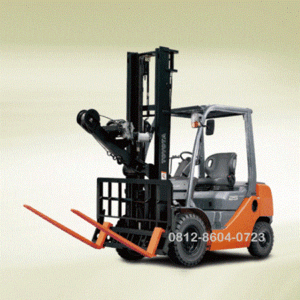
A forklift Fork Positioner is a hydraulic attachment that allows the operator to adjust the distance between the forks from the driver’s seat.
This is essential for handling various pallet sizes quickly and safely.
Below are the typical specifications and technical details for these units.
Core Technical Specifications
When selecting a fork positioner, manufacturers typically provide the following data points:
Specification Typical Range / Description.
Capacity 1,000 kg (2,200 lbs) up to 12,000 kg (26,000+ lbs).
ISO / FEM Class Class II, III, IV, or V (Matches forklift carriage).
Opening Range From “0” (forks touching) to wider than the truck frame.
Lost Load (Effective Thickness) 30 mm – 150 mm (Impacts residual capacity).
Center of Gravity (HCG) Horizontal distance from the carriage to the attachment’s CoG.
Weight 150 kg – 900+ kg (Depending on size/class).
Fork Mounting & Carriage Classes
The attachment must match the ISO 2328 standard of your forklift’s carriage.
lass=”yoast-text-mark” />>Class II: Capacity 1,000–2,500 kg (Carriage height: 16 inches / 407 mm).
>Class III: Capacity 2,501–4,999 kg (Carriage height: 20 inches / 508 mm).
>Class IV: Capacity 5,000–8,000 kg (Carriage height: 25 inches / 635 mm).
Key Operational Features
Integrated Sideshift: Many modern units combine “positioning” (moving forks apart) with “sideshifting” (moving both forks together left or right) using a single hydraulic valve.
Opening Widths: * Within Frame: Forks stay inside the width of the forklift.
Wide Opening: Forks can extend beyond the width of the attachment frame for extra-wide loads.
Mounting Styles:
Hook-on: Standard ISO/FEM mounting that clips onto the carriage.
Shaft/Pin-Type: Heavy-duty style where forks slide on a solid round bar (common in construction/lumber).
Hydraulic Requirements
To operate a fork positioner, the forklift must be equipped with auxiliary hydraulic functions:
2-Function: Required for simple fork positioning.
3-Function: Required if the unit has both fork positioning and independent sideshifting.
Operating Pressure: Typically requires 140–160 Bar ($14 – 16 \text{ MPa}$).
Warning: Residual Capacity
Adding a fork positioner increases the “lost load” (the distance between the carriage and the load). This reduces the forklift’s maximum lifting capacity. Always consult the Capacity Chart provided by the manufacturer before use.
Would you like me to help you calculate the residual capacity for a specific forklift model and attachment weight?

Reviews
There are no reviews yet.