
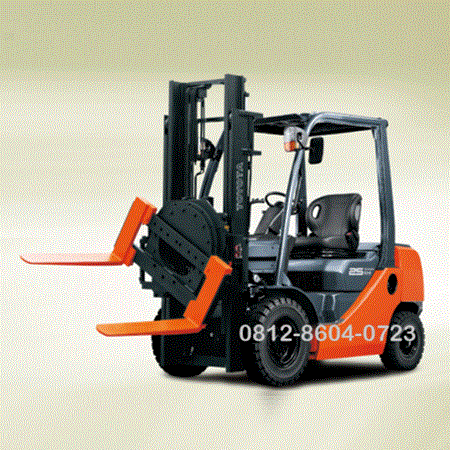
Full Rotating Fork
Full Rotating Fork Attachment
Primary Performance Specifications
These units define the core capabilities of the rotator.
Capacity (@ Load Center): The maximum weight the attachment can handle.
Unit: kg or lbs (e.g., 2,500 kg @ 500 mm).
Rotation Range: The degree of movement. “Full” or “Endless” rotation is standard for these units.
Unit: 360° (Continuous).
Rotational Torque: The twisting force available to rotate a heavy or unbalanced load.
Unit: Nm (Newton-meters) or in-lbs (e.g., 6,800 Nm).
Rotation Speed: How fast the unit completes a full circle at a specific oil flow.
Unit: RPM (Rotations Per Minute) or sec/360°.
Description
Full Rotating Fork
BELIALAT.COM support penjualan unit, parts, service, rental, maintenance contract, overhaul, reconditioned Full Rotating Fork
A Full Rotating Fork Attachment (often called a 360° Rotator) is a hydraulic forklift attachment that allows the fork carriage to rotate 360 degrees endlessly in either direction.
This is primarily used for tipping, dumping, or inverting loads like bins, crates, and containers.
Below are the typical specification units and technical parameters used to define these attachments.
Primary Performance Specifications
These units define the core capabilities of the rotator.
Capacity (@ Load Center): The maximum weight the attachment can handle.
Unit: kg or lbs (e.g., 2,500 kg @ 500 mm).
Rotation Range: The degree of movement. “Full” or “Endless” rotation is standard for these units.
Unit: 360° (Continuous).
Rotational Torque: The twisting force available to rotate a heavy or unbalanced load.
Unit: Nm (Newton-meters) or in-lbs (e.g., 6,800 Nm).
Rotation Speed: How fast the unit completes a full circle at a specific oil flow.
Unit: RPM (Rotations Per Minute) or sec/360°.
Mechanical & Mounting Dimensions
These specs determine if the attachment will physically fit your forklift.
Specification Unit Description
Mounting Class Class II, III, or IV Defines the carriage size (ITA/ISO standard) the unit attaches to.
Frame Width mm or in The total width of the rotating carriage plate.
Lost Load (Effective Thickness) mm or in The distance the attachment adds to the front of the carriage (reduces net capacity).
Weight kg or lbs The self-weight of the attachment itself.
Center of Gravity (HCG/VCG) mm or in The horizontal and vertical center of gravity of the attachment.
Hydraulic Requirements
Since these units are powered by the forklift’s hydraulic system, they must match the truck’s output.
Operating Pressure: The hydraulic pressure required for the motor to function.
Unit: bar or PSI (Typical: 120–160 bar).
Hydraulic Flow Rate: The amount of oil needed to power the rotation speed.
Unit: L/min or GPM (Typical: 20–30 L/min).
Hydraulic Functions: Most rotators require one (1) auxiliary hydraulic circuit to be plumbed to the carriage.
Common Industry Standards
ISO 2328 / ITA: The standard for mounting hooks and carriage bars.
Visibility Window: Often measured by the “open center” dimensions to ensure the operator can see the fork tips.
Safety Note: Adding a rotator significantly changes the Net Capacity of your forklift. Because of the “Lost Load” (the thickness of the attachment) and the weight of the unit itself, the forklift can no longer lift its original rated maximum. Always refer to the manufacturer’s de-rated capacity chart before operation.
Would you like me to help you compare specific models or calculate the estimated net capacity for a specific forklift?

Reviews
There are no reviews yet.