
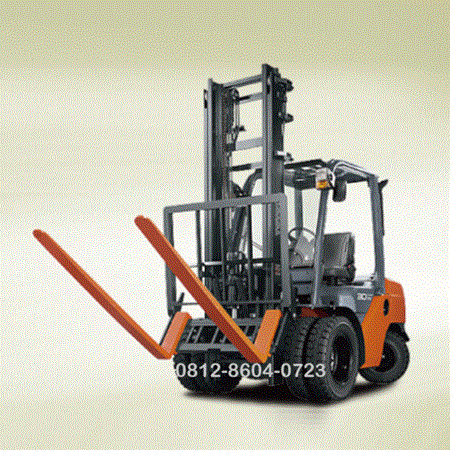
Hinged Fork Attachment
Hinged Fork Attachment
Standard Specification Units
Below is a typical technical breakdown for these units. Note that “Effective Thickness” and “Center of Gravity” are critical for calculating your forklift’s residual capacity.
Specification Parameter Typical Unit Common Range.
Capacity (@ Load Center) kg (lb) 2,000 – 4,500 kg (4,400 – 10,000 lb).
Load Center mm (in) 500 mm (20 in) or 600 mm (24 in).
Tilt Forward ($\alpha$) Degrees (°) 40° – 45°.
Tilt Backward ($\beta$) Degrees (°) 20° – 35°.
Carriage Width mm (in) 1,000 – 1,800 mm (40 – 70 in).
Effective Thickness (ET) mm (in) 300 – 450 mm (12 – 18 in).
Horizontal Center of Gravity (HCG) mm (in) 130 – 220 mm (5 – 9 in).
Unit Weight (Self-Weight) kg (lb) 300 – 800 kg (660 – 1,760 lb).
Mounting Class ISO / ITA Class II, III, or IV.
Description
Hinged Fork Attachment
BELIALAT.COM support penjualan unit, parts, service, rental, maintenance contract, overhaul, reconditioned Hinged Fork Attachment
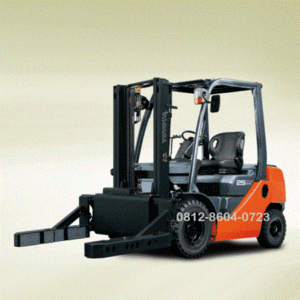
A forklift hinged fork attachment is a specialized hydraulic unit that allows the forks to tilt significantly further than a standard mast—typically 45° forward and 25° backward.
This functionality is primarily used for tipping bulk containers or, when paired with a bucket, handling loose materials like gravel, grain, or waste.
Standard Specification Units
Below is a typical technical breakdown for these units. Note that “Effective Thickness” and “Center of Gravity” are critical for calculating your forklift’s residual capacity.
Specification Parameter Typical Unit Common Range.
Capacity (@ Load Center) kg (lb) 2,000 – 4,500 kg (4,400 – 10,000 lb).
Load Center mm (in) 500 mm (20 in) or 600 mm (24 in).
Tilt Forward ($\alpha$) Degrees (°) 40° – 45°.
Tilt Backward ($\beta$) Degrees (°) 20° – 35°.
Carriage Width mm (in) 1,000 – 1,800 mm (40 – 70 in).
Effective Thickness (ET) mm (in) 300 – 450 mm (12 – 18 in).
Horizontal Center of Gravity (HCG) mm (in) 130 – 220 mm (5 – 9 in).
Unit Weight (Self-Weight) kg (lb) 300 – 800 kg (660 – 1,760 lb).
Mounting Class ISO / ITA Class II, III, or IV.
Key Technical Considerations
Hydraulic Requirements: These units typically require one or two additional hydraulic circuits (auxiliary valves) on the forklift to control the tilting mechanism.
Operating Pressure: Most units operate optimally at a pressure of approximately 140 – 160 Bar, with a recommended flow rate of 20 – 60 L/min depending on the unit size.
Residual Capacity: Because the attachment adds significant weight and moves the load center forward (the “Effective Thickness”), the forklift’s lifting capacity will be reduced. You must refer to a derated capacity plate provided by the manufacturer.
Safety Features: High-quality units include hydraulic safety locks on the cylinders to prevent the carriage from dropping or tilting unexpectedly in the event of a hose failure.
Common Applications
Lumber Industry: Tilting forks to securely cradle round logs or uneven timber.
Agriculture: Used with bucket attachments for grain, fertilizer, or feed handling.
Construction: Dumping waste bins or handling heavy stone/sediment.
Manufacturing: Precision pouring of scrap metal or liquid containers.
Would you like me to help you calculate the estimated residual capacity for a specific forklift model using one of these attachments?



Reviews
There are no reviews yet.